Who Would New Energy Hurt?

Uncategorized

As I watch the Olympics, I see ads running by that advocate Big Oil. One of the ads that ran by was ‘Energy Tomorrow,’ an online resource.

Now, given the title, I think I’m going to hear about Solar, Wind, Geothermal, Biofuel, the big ‘energy’ words.  Instead, I find a website dedicated to promoting the benefits of Natural Gas and Oil.  These are ‘proven technologies’ (or incumbent tech) with new advances being made to access more of those resources at home.  What’s more, they have jobs: they hire people, they have a growing industry.  That’s the other side of coin.  As demand goes up around the globe, the market solution is to feed it.  More demand, more business, more jobs, more employment.  Big Oil is a friend to the people, and they make sure you know it – both in their televised ads and on their website.  They also want you to know that they’ve spent $188 Billion in research on alternative fuel sources, which for them, includes natural gas.  So why the advertisement push?

Right now, the big danger to Oil are new taxes being proposed by the president.  If there’s one thing that’s historically un-American, it’s taxes.  It’s what made us go to war to make this country.  It’s the reason the government runs the oft-reviled IRS.  From a government standpoint, it’s what funds the government and one more way for the government to control the populous.

I looked into the Energy Tax link, and I didn’t find what was being taxed, or how, but I did find the following:

  • New taxes kill jobs. …new taxes could hurt workers by depressing job creation…

My response:  Granted, this will naturally happen, but the big companies are saying that if we tax them, they’ll let the little guy go.  We’re not saving the environment, we’re hurting the working man.  Okay.

  • New taxes hurt consumers and businesses. Historically, higher taxes result in less domestic energy, and […] higher energy costs for consumers […] stifle a recovery […] leave Americans more dependent on foreign oil and natural gas […] fewer jobs for workers […] less oil and natural gas for consumers and businesses.

So, if we tax big oil, they’ll get more outside oil.  Or we will?  Again, we’re hurting workers.  But!  There will be less oil and natural gas consumed.  Okay.

  • The U.S. oil and natural gas industry is one of the success stories of the American economy, supporting 9.2 million workers in good jobs that offer good wages and benefits. Additional taxes […] drive these jobs overseas…

Ah, here’s the problem:  everyone works for the oil industry.  If they can’t employ good Americans, they’ll employ good Arabians, Iraqis, Afghanis, Africans, or anybody else who will work for the benefits of exchange rates and lower property rates.  And again, if taxes hit them, then Big Oil will hit American workers.

  • Millions of Americans have seen their retirement savings shrink. Billions in new taxes […] will hurt millions of Americans whose retirements depend on mutual funds, pension and retirement plans that own oil company shares.

Not just any Americans, but old Americans.  Grandma and Grandpa will starve thanks to oil taxes.  If big oil gets hurt, so will grandma and grandpa.

  • Plans to strengthen America’s energy security would be undermined since higher taxes would lead to less—not more—domestic oil and natural gas production. All reputable forecasts show that oil and natural gas will be required to meet the majority of America’s energy needs for decades to come. As the economy recovers, America will need all the energy we can produce. Higher taxes would rob the industry of the capital it needs to invest in alternatives and reduce supplies of the oil and natural gas needed as a bridge to the future.

We have to spend more oil.  We have to.  It needs to be consumed.  I mean, look at it.  Just sitting there.  Oil.  Man,  remember back when we first found it and everyone was like ‘hurray!’  Yeah, well, let’s keep on doing that.  Also, we’ll need more energy and apparently, going electric, which (by the by) uses gas, coal, and oil anyway, isn’t the right thing to do: it’s all about buying more oil for higher and higher rates.  These new ‘renewables’ can’t account for the kind of energy that oil accounts for… unless we pay to research it, or make a competing industry.  But with this tax, we won’t be able to have alternatives, we won’t have the oil and gas we need to have… more gas… and… more… oil?

  • Current tax policies do not provide taxpayer subsidies to the oil and natural gas industry.

I didn’t include this paragraph because all it does is use angry adjectives to call the tax policy ridiculous.  It’s all emotional appeal without reason.  That being said, the above is true.

  • There is a better way than saddling a troubled economy with new taxes that hurt American families.

American families.  Again, we’re not hurting executives, we’re hurting the poor, the overpopulated, undereducated, the obese and the malnourished of America.  But we’re also hurting the wealthy, the secure, the dysfunctional, the fit, and the emotionally underdeveloped.  Higher taxes hurt the Rich… and the poor.

The problem is, I am biased: I want to see change.  I don’t see how electricity, wind, solar, and bio are so bad.  I do see how they are new and threaten the current business which is incredibly able to influence policy, and has been for the past eight years.  I do see the ‘families’ argument.  Taking down Big Oil a peg or two means hurting the common man, because Joe Worker works for the Company Store.  He can’t work elsewhere, they’ve got the best benefits.  They’ve got the most money, the most people.  So if you take away that money, you put Joe on the street. And what did Joe ever do to you?

So how do you counter Big Oil?  What do you if you support the taxes?  So, what are these taxes about?

From Paul Davidson’s article in USA Today, 2/27/2009, located here:

The proposal would raise the following over ten years:

• $5.3 billion by imposing a new 13% excise tax on offshore oil and gas production in the Gulf of Mexico to close loopholes that gave companies relief from certain royalty payments.

•$1.2 billion by charging a fee on companies that don’t produce on their Gulf leases.

•As much as $10 billion by reinstating taxes to clean up hazardous waste sites.

•$11.5 billion by barring companies from writing off drilling costs, such as labor, and by limiting their ability to write off lease payments.

•$13.3 billion by scrapping a 6% tax deduction that benefits all U.S. manufacturers.

Industry profits in the U.S. totaled $125 billion in 2007, according to the Energy Department.

So, if we look at this, the costs are $42.3 Billion over the next ten years.  If the Industry continues to make (we’ll measure on the weak side) $120 Billion a year over the next 10 years, then they’ll garner $1200 billion in profits.  This means that these taxes will cost the industry 3.4%.  Take that to an ‘unemployed populous’ and that  makes 312,800 old American workers with families that Big Oil is putting in front of the ‘gun’ of new taxes.   The answer for them should be in a growing Renewable Energy industry, or even in the oil-reliant Electricity Industry (which is oil… just used more efficiently).

If you’re one of the 312,800 outed by the big companies, odds are you’ll be in a renewable energy research job.  Big Oil may have spent $188 Billion on ‘new energy,’ but they won’t want to be totally replaced. Their findings will probably be dubious, at best. The best way to get around this is through educational research and small company competition.

Make a small company that forwards alternative energy:  America is founded on the spirit of the small company.  Through labor, hard work, forward thinking, and diversity, the American economy can expand, even in the field of energy.      One small competitor in oil can be quashed, but one that works with unrelated industries can find a way around large competitors who rely on foreign products, heavy traffic, grease, smog, and capsizing ships.

For the voting public, support the new tax.  If you like monopolies, never mind.  If you like clean air, increased efficiency, and a diverse job market, vote for the tax.

Transport Business Idea

Environmental Architecture, Plans

Having  just watched Chris Blaine’s “Who Killed the Electric Car?” on freedocumentaries.com,  I’ve got a fun idea.

Based on the theories put forth in the documentary, the socio-political-economic situation of America is too wrapped up in profit to make a commercially viable vehicle built by a major domestic company.  As the film lays out, either through poorly conducted marketing or public near-sightedness, electric cars are not viable as profitable products.   By viewing the influence of Big Oil, we see that financial push from the large incumbent of energy is too strong to defeat in a market scenario.  Then, when looking at the nature of the car company itself, a lack of constantly replaced parts reduces the financial incentive to produce such a vehicle.  When looking at the nature of both the local and national government, the desire of the people, both rich and poor, allows the first three issues to show that government influence on a profitable company will not help create a more efficient car, especially with a four to eight year turnover in government policy creating inconsistencies.  As a profit driven endeavor, the electric car won’t work for an American market.

The solution, then, for an American made electric car, is to create a not-for-profit company.  This company, through donations, links to educational institutions, constant exposure, and creative problem solving, would generate a commercially competitive electric vehicle that is made without regard to the company’s profit.  Thus, the company would be driven on the power of an idea rather than on the promise of increased profits over time.

The issue with only making a car leaves the question of fueling stations.  This initiative needs to be taken in cities where the environment is a priority.  Using these as starting cities, the company could make contracts with local businesses -not necessarily gas stations, but parking garages, lots, and restaurants – to expand the range of recharging facilities.  Working with various industries increases the odds of support that cannot easily be bought – or rather, stretches thin the influence of large companies opposing such business.  As certain cities expand in their influence with a short distance car, more cities can be brought in, longer distance battery models sold, and the idea of the electric car industry expanded.

The benefit, even to detractors of the electric car, would be a city by city case study where the efficiency both of the product and the business of the electric car could be critically studied.

This company would be most effected by state and federal policy as a not-for-profit, so lobbying from large corporations would threaten it the most.

However, if a desirable conversion for a business model was needed, one needs look no further than the computer industry.  These products operate on an electric system and have constant profit and advancement.  The industry makes large profits continuously and continues to grow and expand.  Why should an electric car industry be any different from the computer industry?

Tying into an earlier post, the potential of wireless charging makes the electric car that much more viable.  If the ability to charge the car becomes wireless as well, we’d have a car that charges as it travels, removing the fear of loss of fuel in suburban towns and cities.

Anyway, that’s my response to the documentary “Who Killed The Electric Car?”  I think the more important question is: how can it brought back to stay?

Making Electric Car Society

Environmental Architecture, Theatre Business

Recipe for a working electric car society:

  • a little wireless charging, as seen here:

http://gajitz.com/cutting-the-cord-wireless-electricity-no-longer-sci-fi/

  • a little hybrid car/ electric-only car, as seen here:

http://auto.howstuffworks.com/hybrid-car.htm

mix with the current  american road system and bam!  A very efficient electric car society.

The idea behind this system is that around stoplights, parking garages, tunnels – anywhere where cars are surrounded either by four walls or where they are stopped (or both), wireless chargers are inserted into the roadsystem.  What this allows is continuous recharging of the electric car.  Combine that with solar or geothermal powered wireless chargers and you get a low-oil/ natural gas system that keeps the American tradition of individualistic driving.

Fine: How do you pay for it?

Advertising.  Sell ad space in garages, on highways, so on and so forth.  Google has made the free-to-consumer approach work wonders through simple use of advertiser space.  If this method of marketing keeps the ever popular internet super-highway cheap, why can’t the real highway system use a similar method?

Why does this matter for theatre?

Most theatre patrons belong to demographics that concern themselves with driving, luxury, and environmental action – on either end of the polarity.  They can afford to take part in the energy/ road system conversation.  That being said, the theatre industry itself is one of constant transport – be it between the suppliers and the space wherein the set is built or simply on the touring bus in which the company travels, roads are part of theatre.  Travel – either by the public or by the troupe – is vital to the survival of the theatre company.  As such, a greener system can also be a cheaper system, which is always good news for an industry that needs every penny it can get.

In addition, the idea of the wireless charging system could also help with rigging.  Over time, if a system of wireless power is established which can handle the high-energy connections necessary, then lighting for a theatre could eventually remove (or back up) cable systems.  This would make for a safer, lighter rigging set up – or simply one that can back itself up in case of emergency.  However, this level of innovation might only take place if funding were available, and if the much broader category of transportation takes on the wireless issue, then the funding boom could expand to other industries, such as home, office, and eventually, theatrical lighting.

Furthermore, a wireless system might also help the international plug issue.  By having a universal power type – simple coil to coil transfer – then various plug types would no longer be an issue (though perhaps various brands of coil might be incompatible for the benefit of each wireless power source company)  Once again, this effects most levels of a traveling society, one part of which are the theatre companies that work internationally.

All in all, I see wireless charging as being a huge boost for transport beyond all else.  In most other areas, it simply acts as an alternate aesthetic – appealing as that is, I like the real improvement made by connection with transport.

Images!

art, Plans

Hi world! Long time no post.  A while back, I promised images/daily webcomic.  I got meself a scanner! (woot).

Anyway, I have images.  they’re included in this post and up for review from you, the world (wide web).  These images are open content, just please cite me as the author.

Four figure studies in the comic hero tradition

Four figure studies counter clockwise: character with blades, spidey variant, lady martial artist, lady with blades

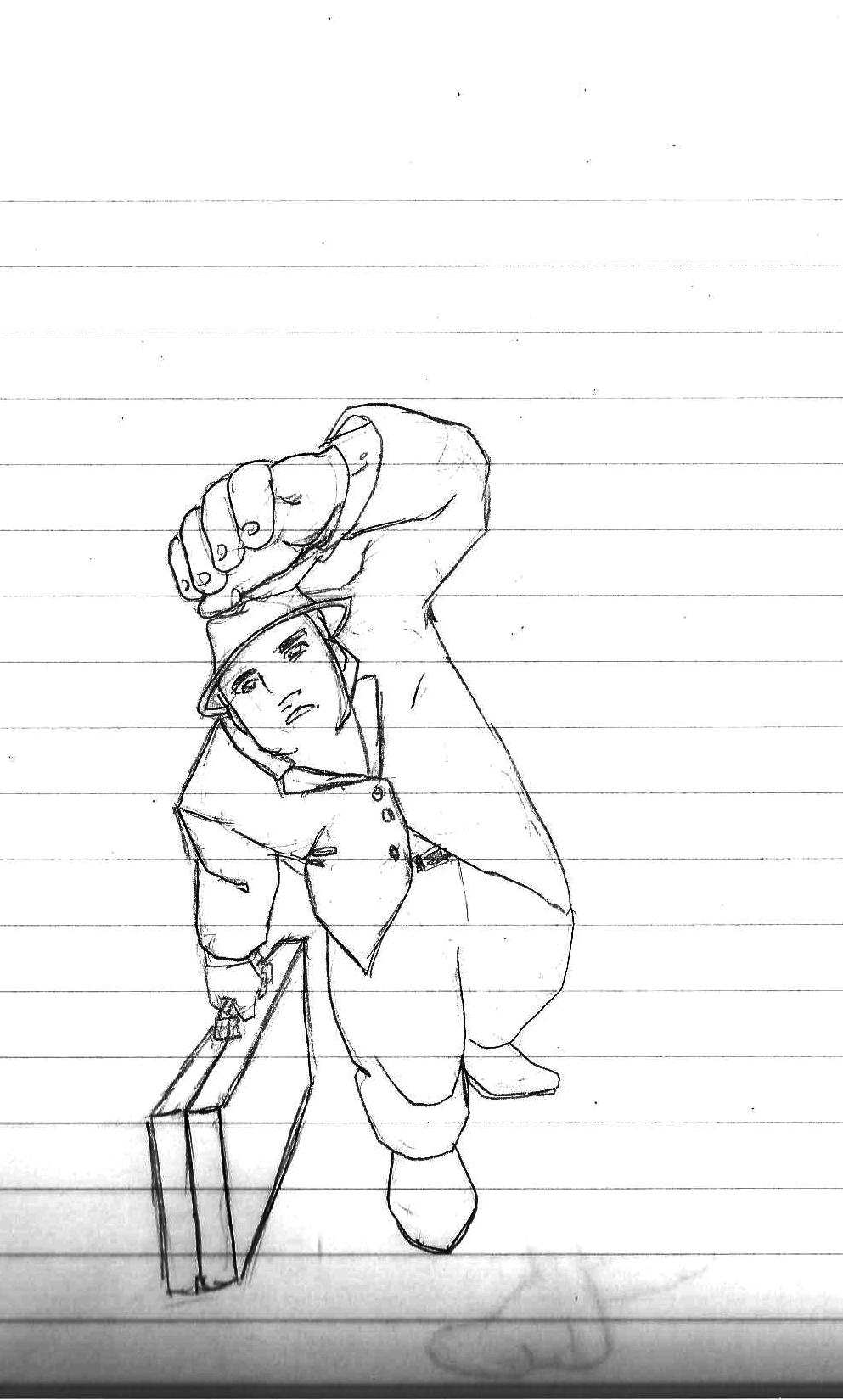
Suit in the Sun

An excerise in perspective, proportion, and figure.

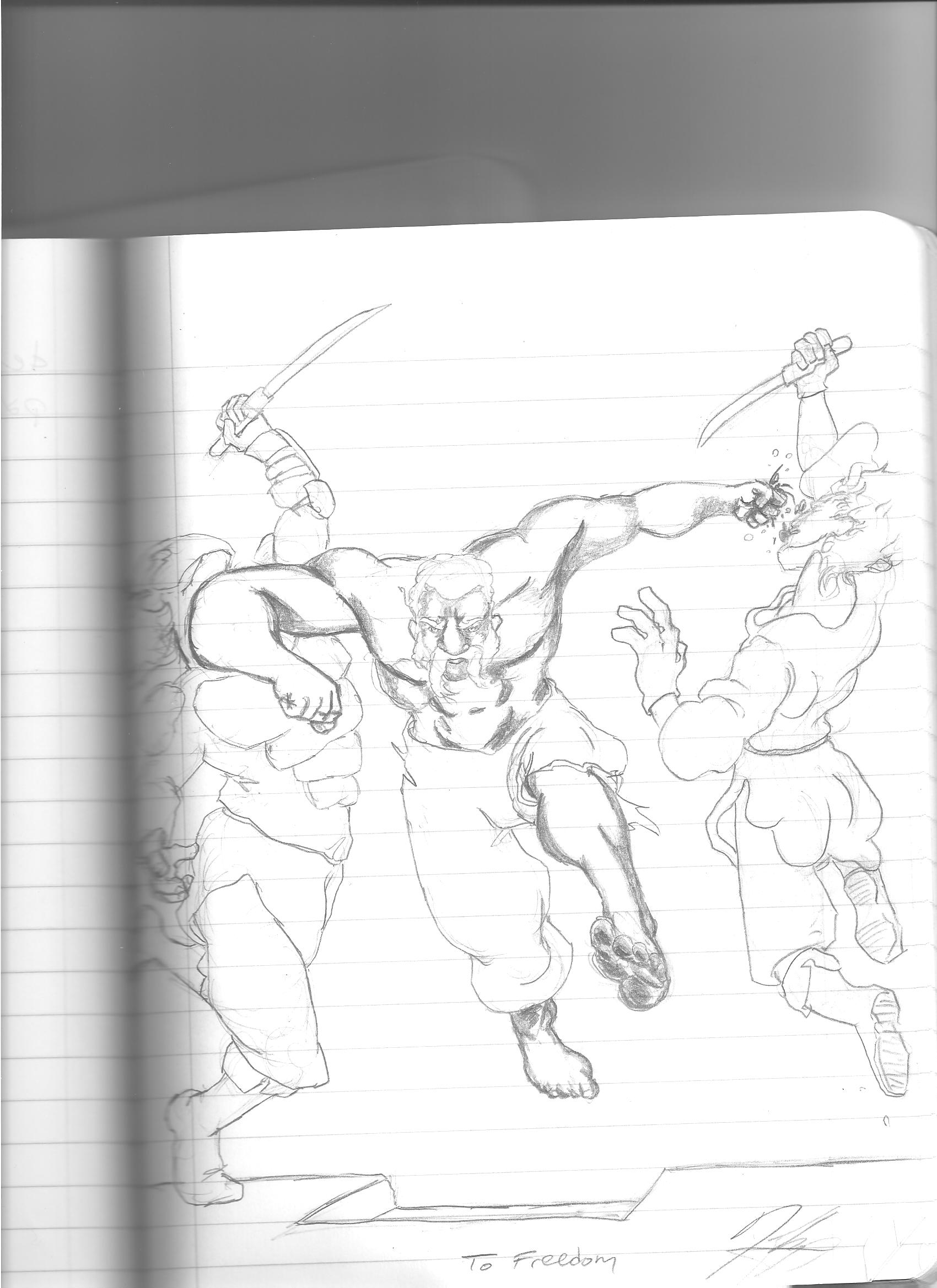
To Freedom

A slave islander breaking free from his captors in the melodramatic adventure tale tradition, with a postcolonial twist

The figure group took about 5 minutes per figure (if that).

The suit took 10 minutes: circles, outlines, face, fingers, clothes, suitcase, heavier overlay lines.

The freedom image took about an hour, with the same process being used as the suit, but with more overlay and detailing.  I know this time more precisely because I spent a music ethnography class working on it.   Yeah… I don’t doodle when I doodle…

Questions/comments/ concerns? Let me know.

A Question of Details

Uncategorized

Here’s the train of thought that came to mind recently:

“I want to work on initiatives within the theatre that encourage Green practices.”

“One such example would include using laminated bamboo in place of luon, for which the industry is using rainforest lumber.”

“Using laminated bamboo would require testing, mass production, and an owned site in order to match the lower costs of current alternatives.”

“If such a site was created and made commercially viable, then it would effect the luon trade.”

“If the luon trade were disrupted, would this help or hurt the rainforest?”

“How could one protect the rainforest?”

“Aren’t there miles of land protected around various Tourist locations around the world?  Doesn’t tourism help fuel the economies of many developing countries?”

“Who is one of the biggest international Tourist groups?”

“How can people get Disney and other Tourist groups interested in the Rainforest?”

“How can these Tourism sites keep people out of the protected rainforest while still encouraging visitors to the sites?”

“How can local workers and current economies be drawn away from the rainforest and into the tourism business and still maintina their local culture?”

“How can all of this use green principles to help reduce costs in the long term.”

Back to Base-ics

Environmental Architecture

NASA’s recent Sustainability Base project is an interesting step forward in the United States government’s involvement with the Green movement.

Their videolink for the project can be seen here.

What I find interesting is that the rhetoric for the project includes global ideas of climate change, which is a political hot-button.  Whereas I’m not opposed to efforts to stem climate change, I know several people who don’t believe in the theory (in addition to the various groups which oppose the idea).  There are arguments for and against this idea, but I think, personally, when an item gets too hot, its best not to touch it.  I prefer to look at the economic impact of the movement, and especially of NASA’s new Sustainability Building.

In an earlier article, I looked at the Solar Decathlon in DC, which has similar results to NASA’s new building.  What I liked about the two different projects was the use of renewable resources and the construction of buildings which would produce net zero energy (although I don’t see why NASA’s building shouldn’t attempt to mimic Team Germany’s structure and simply create an energy profit).  The reason I like these initiatives is the financial incentive.

In Conte and Langley’s Theatre Management Handbook, one of the operating expenses of any theatre house is building upkeep and maintenance.  These line items cost a good deal over time, and reduction in their cost allows for more expense for entertainment and, more importantly, education.  By creating and updating structures to help them reduce their upkeep costs and maybe even pay for themselves, managers can either generate more profit (always nice) or help assign income to other expenses and budgets.  Using more renewable resources allows for buildings to made and landscapes to expanded with a less destructive nature.

To clarify:

Matter can neither be created nor destroyed, so how is any building of a site destructive?  I think the proper definition for ‘destructive’ in this context should be ‘to be made inaccessible.’  In that case, creation simply means then, ‘to be made accessible.’  Which then means that finding alternative sources of energy and renewable resources are both creative acts, which by the same credit, refining current methods of energy production also achieves.


However, the danger in all these movements is balance.  It is hard to raise the funds necessary for a given project when diversity exists, and yet it is important, especially now, to have a diverse energy market which uses diverse sources and resources – otherwise, we exchange immediate surplus for an eventually drought.  Right now, it seems that we are facing a drought in the current supply of carbon fuels, and even with the various solutions available, the increased access to as-yet untapped resources proves to be another hot-button issue.  Therefore, I believe the more harmonious path is through diversity of energy resources as well as the development and refinement of more renewable energy.


The Story of Spider Island

Uncategorized

Once upon a time, on a far away island in the middle of turbulent sea, there lived a tribe of people.  These people were much like the people you see every day – two arms, two legs, a head, a torso, loins.  They did the things that your people do: they ate bread, meat, vegetables; they sang songs, performed plays; they studied the philosophies of the world.  They were a people like every other people.  They lived at first on the south side of this island, a conic patch of soil with a dormant volcano in the middle.  They spread over the island slowly, mapping it and studying it and living and dying on the island.  Eventually, they lived in a great tribe that spanned the entire conic pile.

And as they studied the island, they learned much of its dangers.  And they danced and they sung and they believed that above all, they must live and thrive and never die.  Beyond all else, the people feared death: for of all things, the one thing that the people studied that they did not understand was dying.  They knew all the properties of all the parts of the island, they knew how the island worked and how to make it work for them, but they did not understand death.  So they made medicines and rituals and arts and philosophies to stave off death, and they lived longer and longer.  And they kept making children, and living lengthy lives, and covering the island with people.

And one day they found that they could not feed everyone on the island.  And they were faced with a choice: set out in the waters to find more food, or stay on the island and starve.  And the people went to the water and they made rafts.  And they found fish and fed their people and for a time, there was less starvation and the people were happy.

And as they ate more, they grew more, both in number and in age – they lived longer and longer and made more and more children.

And soon, the fish were not enough.  And over time, there was not enough room for both the living and the dead on the island, and the people were crowded, and the people were hungry, and there were only so many rafts.

So a few of the people on the crowded island made boats that were stronger than rafts.  But these boats took much lumber that people needed for houses and for food.  And many of the tribe people were made angry by the creation of these boats.  And the makers of these boats, the boatmen, fled into the waters.

But the tides turned against the boatmen, and while a few lonely boats made it safe into deeper waters, many of the boats returned to the island, their passengers barely alive, crashing onto the shores of the island.

The people of the island, seeing that the boats had failed, took the remaining passengers – those who were still alive – and brought them before the tribe elders, who gathered around the great fire, which brought heat, and knowledge, and purity to the food and water of the people.

And the elders of the island said

“these boatmen have traveled out into deeper waters, and have returned starved or dead.  there is nothing out on the water but death.”

and the people said

“but there is nowhere on the island for more people. what are we to do?  we are too many, we cannot feed ourselves, we cannot house ourselves.  Cannot we head out onto the water?”

and the elders said

“the waters we do not know. We know the island, we know the people.  Surely there is a solution in our infinite knowledge of this place.  we do not need to go into the water.  that way lies only death.”

and the people said

“then what shall we do?”

and then the eldest of all the elders spoke

“bring the boatmen to the fire.”

and the people obeyed, trembling.

“place the boatman on the fire as we would the water, for they have gone to the water, they are now the water.”

and the people obeyed, crying.

and they roasted the body of the boatman.

and after a time, the eldest elder spoke

“remove the body from the fire. leave the husk on display.  we shall never again venture into the water.”

and the people obeyed in silence.

And the people starved and grew so numerous they knew not who was kin, and they knew not each other as people no longer, but as various animals upon a small place.  And the tribe shattered, and war erupted, and no man trusted even his brother.  And the elders vanished, retreating into their clans.

And after a time, the various tribes came to a peace, for they had slain each other time and again.

They said “we have seen that making too much life has led to war or starvation.  We must again use our knowledge to guide us.”

And so the people stopped making children.  They used their sciences to remove their organs from themselves and alter their forms and they stopped producing children.   And over time, they grew fewer and fewer in number and had to rely more on their own personal talents for survival rather than working in groups.  And the various clans convened, and spoke.  They said:

” We are dying.  We need to make children again.”

“But if we do so, we shall starve.  We have been through both peace and war and both have led to pain.”

And the tribes all became silent with thought.  After a time, the grandest grandson of the eldest elder, who had first had the boatman roasted, spoke.

“Why did we not eat the roasted boatman?”

And all the tribes in all their thoughts looked with shock at the grandest grandson of the eldest elder.  And again he spoke,

“We have seen war and we have seen peace; and both life and death, left to their own devices, have left us bereft of our people.  We control all parts of this island, we have even controlled life itself.  Why not also control death?”

And the tribes all cried

“The waves are death.  The sea is death.  We have no control on that.”

And the grandest grandson cried back

“The waves are the unknown.  Death may lie in their wake, but it also resides here, on this island.  And it is our island.  And we know all its secrets, so surely as we know life, surely as we know this island, we also know death.  And so, in knowing, we can control it, and in so doing, we can control life.”

And the tribes people all spoke all once, in a fury.  Finally, one voice from the crowd rang out.

“Then what shall we do now?”

And the grandest grandson replied

“We shall create life again as we have in days of old, yet we shall take it also.  He who cannot survive on his own shall be consumed by those who can, and in so doing, we shall rid ourselves of the weak and create life without starvation.”

And the people again spoke in a thousand voices, rumbling.

And again, silence fell, and a voice rang out:

“We shall abide by your law, for in nothing else have we found solace.”

And the grandest grandson nodded.  Then he looked with horror as the crowd descended on him.

At the place of the great fire, where once the elders had gathered, the many tribes reunited, and they took the grandest grandson, and made him the first of his tradition, and roasted him, and ate of him.

And this is when they began to change.

The people, one by one, became afraid if each other, and of the fire, and of being seen.  They took to consuming each other, and over time, became recluses, hiding in all the secret places of the island.  They turned inward over time, as they grewer fewer and fewer, and they began to change in form.  They changed bodily.  They grew extra arms and legs, becoming able to do many things at once. They grew extra eyes to see all around themselves, even in the darkness.  They no longer knew each other, male nor female, but as one entity with all life inclusive, producing children whenever it consumed enough to do so.  These creatures bore children more rapidly and in greater number than people, only to have their infants consume each other in the same competitive way as the rest of the people, leaving only the strongest to survive.  They no longer fed on the plants of the island, devouring only animals and each other.  They became deadly masters of their terrain, knowing it intimately and always for their own personal gain.  And so it came to pass that the various tribes dissolved and never again knew peace nor war, but only a constant reproduction and consumption, a never ending tension of hunters and trap-layers.

And time passed. And the seas grew calmer. And one day, a fleet of boats returned, with white sails and great cargo holds of food.

And the grandest grandsons of the first boatmen returned to the Island.

They thought the place abandoned, for they saw no signs of life.  They resettled the island, colonizing it in the names of alien places.

It was when their people began to dwindle and disappear that the grandest grandsons of the boatmen began to worry about the ghosts of their dead ancestors.  Taking up arms from alien worlds, they worked together, scouring the island.  After a time, they found a hiding place of one of the recluses.  Its traps caught one of their band, and the rest stayed to save him.

With its superior knowledge of the island, the recluse ensnared all of the boatmen save one, who freed his fellows and carefully gathered them all together.  But they were weak and needed rest, and the recluse lingered closer and closer.

Just when all seemed lost for the wayward band, the recluse was consumed by an even greater recluse, and the two locked in battle, attempting to slay each other.  The band of boatmen trudged on, struggling toward their boat.

The smell of fresh, untainted meat tantalized the recluses all around the island, and the various monsters scuttled and battled their way to the group.  As a seething horde of self-consuming monsters encroached on the boatmen, the small team used the last of their strength to board a boat, pull up anchor, and flee from the cursed isle.

In later years, the boatmen would write of their ancestral homeland, calling it ‘Spider Island,’ a land of cannibal monsters, and warned all other boatmen never to return there.

And that is the tale of Spider Island.

Additive Architecture

Environmental Architecture

Considering the fields of Theatre, Economics, Environmental Sustainment, and Architecture, I’m beginning to feel that a more conservative approach to the Green movement is necessary.  There are plenty of locations where mega-mansions are being built, huge, new, Green houses that take a lot of money and time and labor, but will eventually pay for their own costs.  What I’d like to see more of is tweaking: taking existing spaces and making them more green without demolishing them.  In other words, using the resources that are in place and making them more efficient.  One could say I’m advocating ‘baby steps’ in Architectural Sustainability, but there are more factors to consider in the Green movement than ‘houses that pay for themselves.’

What I’ve seen so far that I’ve liked includes the Gable House, a structure built using ‘lamboo’ – laminated bamboo – and resources from condemned farms, to build a house.  What’s excellent about these two materials is that the first is rapidly renewable – bamboo is a grass and if improperly contained, becomes an invasive weed; and that the second is a reused resource – in essence, it’s good waste management.

Detractors say that liberal approaches to Green Architecture lead to a higher carbon footprint in that resources must be transported to a site to build, whereas more conservative approaches lead to less transport and building.  They also argue for conservation of culture – especially those interested in historical landmarks.  I don’t entirely disagree with them.  However, living in Colonial Williamburg, I will say that over- conservation eventually leads to marketed celebration and a biased viewpoint of history.  In other words, nostalgia, like all things, should be taken in moderation.

Now that I’ve poo-poo’d CW, I will laud it: several years ago, the Foundation switched over to less authentic electric candles.  Preservation is important, but only to a certain extent.  If the Colonies had had electricity, I’m sure they would have used it.  After all, history shows that eventually, they did.

Anyway, what I’m saying is that one need not build an entirely new building in order to produce a grand eco-site.  Especially those in theatre, who someitmes used condemned buildigns as playign spaces.  Theatre should act both as a conservative function of culture and a progressive one.  By using the old ways and the tried and true aspects of a culture, it can also act to fix problems within a given society.

Looking at that role, one can extrapolate the ideology to architecture.  Rather than destroying condemned sites to build new green spaces, one can modify a dilapidated space into a more useful and efficient site.  This allows for both progressive movements in architecture and culture as well as a preservation of history and a conservation and reuse of resources. Especially in the Theatre, this approach would allow organizations to make a sustainable home while still paying homage to their roots (or at least their patron houses).

Commedia Dell’Awesome

Plans, Theatrical Process

So, we just did some commedia dell’ arte research in class today, and I’m on another inspiration trip.  As in, I think I can use some of this for Gondoliers. For those not in the know, I’m going to be directing Sinfonicron Light Opera‘s show this winter, and I’m really looking forward to finding exciting ways of connecting with my cast.  Commedia seems like an excellent model for a lot of character work.

Let’s look at the archetypes and the cast:

Archetypes:

  • Pantalone – an old man with money whose use of Arlecchino gets him into trouble. often fondles his bag of coins, and often beats his servants with a slapstick.
  • Dottore – the old man’s best friend/ rival who is known for long speeches with comical effect.
  • Capitano – a braggart with a huge upward tilting nose and a retracted pelvis, brags about wooing and winning fights, then runs from direct conflict.
  • Zanni – the chorus, a bird like group of servants, driven by baser needs
  • Arlecchino –  a monkey like servant known for his gluttony, given tasks by pantalone which he messes up, leading to the misadventures of commedia.
  • Colombina – arlecchino’s fellow servant who gets him out of tangles – the more sensible servant.
  • Brighella – something like the merchant dealer at the docks, a more dangerous character.
  • Tartaglia – a turtle like stuttering character.
  • Pulcinello – also a more dangerous character, this is the hunchback, who is either smart-playing-stupid or stupid-playing smart.
  • The Enamorati– lovers who are ridiculous for being so into true love (whereas all other characters are humorously driven by their baser needs).

The Gondoliers cast:

  • The Duke of Plaza-Toro
  • Luiz, his attendant
  • Don Alhambra Del Bolero, The Grand Inquisitor
  • The Duchess of Plaza-Toro
  • Casilda, daughter of the Duke & Duchess
  • Marco and Guiseppe
  • Tessa and Gianetta
  • Antonio, Francesco, Giorgio, Annibale
  • Fiametta, Vittoria, Giulia
  • Inez

How do these fit together?

  1. The Duke of Plaza-Toro => Capitano/pulcinello: he is a braggart in the first act, but when he returns, he is a clever conniving friend.
  2. Luiz, his attendant => enamorati/ servant, a lover but also a servant (royal by birth)  mostly he plays into the idea of the lover.
  3. Don Alhambra Del Bolero, The Grand Inquisitor =>Dottore: he has many grand speeches and uses much high faluting language which is often as innaccurate as it is ridiculous.
  4. The Duchess of Plaza-Toro => Brighella: Throughout, she is a conniving character capable of swindle and corruption, and that makes her funny.
  5. Casilda, daughter of the Duke & Duchess => enamorati: she is pretty much also a lover character.
  6. Marco and Guiseppe => zanni (arlecchino?)/enamorati: being lower class and more comic, this duo tries to run a kingdom by doing everyone’s servant duties for them… however, they do so with the best of intentions.
  7. Tessa and Gianetta=> zanni (colombina?)/enamorati: the wives and friends to Marco and Guiseppe, these rather take-charge ladies prove to be the sort of problem sovlers that colombina might embody.
  8. Antonio, Francesco, Giorgio, Annibale => zanni (can be given various characters by type): the gondolieri chorus is pretty much a batch of zanni.
  9. Fiametta, Vittoria, Giulia => zanni (also, characters by type): the contadine chorus likewise is a batch of zanni.
  10. Inez => colombina/ pantalone?  she really does unravel the riddle of the play, but it is also possible that alhambra is her arlecchino, and she in and of herself is pantalone – the foster mother of the king would probably be fairly well off.  probably much more colombina.

Beyond Analysis

My plan with all this is to use these archetypes to help my actors work from the outside in, getting their physical conveyance out and accentuating the comedy of Gondoliers using a traditionally Italian method.  I want my actors to be able to embody their characters and play that comedy, even if it is on a much more subtle level than masked, traditional commedia.

An Invisible Building

Environmental Architecture

Having gotten through season 1 of Joss Whedon’s Dollhouse, I have been inspired by the concept of an ‘invisible building.’  In other words, I love the idea of a closed system underground structure.  Granted, such systems also exist in such games as Fallout 3, but Dollhouse coined the phrase ‘invisible building’ and made it seem more like a paradise than a containment facility (okay, so it showed both sides of the coin…)

This inspiration led to my recent wiki-pedition about closed systems and renewable energy, i.e. solar, geothermal, wind, biomass, biofuels, nuclear power, and others.  What I find fascinating about these various systems is the concept of a 0- energy space (or a space that gains rather than spends energy, as exhibited by Team Germany in the Solar Decathlon).  I think that, by combining these energy resources with an underground structure and clever architectural planning (building or converting abandoned spaces) one could make some amazing ‘invisible’ buildings that pay for their own energy, and perhaps, in time, for their own construction costs.

What this led to think about more, however, was the idea of a vehicle as a closed system.  What if cars, motorbikes, planes, trains, what have you- could use some of the above systems for their own energy refueling?  I mean, ideas of biofuel and solar power being used in cars are not new, but what about wind and hydro electric power?  I suppose my query is one of scale: that is, what if the systems currently used to harness wind and hydroelectric power were scaled down to be used in a moving closed system instead of a stationary one?  What if a car’s movement helped fuel a car?

Fish, for example, move about, generating oxygen by passing water through their gills.  Why can’t cars do the same thing with fuel (or at least electricity)?  Why not have a moving system that feeds not only on solar energy and biomass but also on micro-windfarms and micro-dams?  I mean, granted the systems in question would provide very little energy, but the constant motion of a vehicle would reduce the variability of water intake/wind intake that often plagues the stationary systems.  On that kind of note, could not the very act of falling be used to provide some sort of energy?

What got me to wondering about vehicles on an energy saving level was the idea of transport.  Right now, building in spaces with resources that one orders still requires a lot of energy, a lot of carbon.  It also deals those darned shipping costs.  But what if travelling did not cost so much?  Wouldn’t that reduce the price of construction?  Would that also reduce the price of fuel, and of the vehicle itself (over time)?

To answer my last question, water intake systems come with a cost.  The passage of material through a ‘pipe’ system leaves residue, and overtime, even the energy saving systems of a vehicle would lose their functionality.

Still, having a world (or even a place in the world) where building and travelling actually paid for themselves, would be incredible – and could help direct money into more leisurely areas.