
Chapter 5 is ready for your reviews!.
This is on my ‘witches of iz’ site, and I would love your feedback on it!

Chapter 5 is ready for your reviews!.
This is on my ‘witches of iz’ site, and I would love your feedback on it!
Avalanche Theatre Company has just posted their upcoming season! Check out the info on my theatre company!
As always, thanks for reading.
-K
Check out Jon Jon Johnson’s take on Joy and the theatre. He’s working on Six Characters in Search of an Author right now over at WSC Avant Bard, and his post is a pretty cool reminder of something that working actors can forget pretty easily.

A Clash of Kings
by George R.R. Martin
Clashing Kings
In the wake of the political intrigues of Game of Thrones, the Realm of Westeros is torn asunder as kings sprout from the various feudal factions. In the meantime, magic begins to seep back into the world as the Mother of Dragons seeks an army to return her to the Iron Throne. The key plot of the novel is that a comet shows up in the sky; three kings contest the Iron Throne, and one very estranged Queen attempts to gather an army of arabian knights.
Take to the Sea
Martin continues his tradition of viewpoint- controlled chapters, with a few new characters sprouting up in this second installment: Davos and Theon Greyjoy (who you might recall from the first books as the ever-smiling companion of Robb Stark). Martin uses these two characters to explore a new aspect of his realm which has formerly left untouched: the sea. Davos is a smuggler turned knight, and Theon is a ward turned sea-raider. Davos chiefly acts as the insight to the workings of the ever-mentioned but seldom seen Stannis Baratheon, and Theon gives light to the actions of the Iron Isles. Martin writes his sea-stories fairly well, I think, and while he’s no Herman Melville, he also doesn’t indulge in chapter long dictionaries of whales (cough cough Moby Dick cough cough). In the first book, he wrote three contrasting narratives: the arabian myths of Daenarys, the high fantasy of Eddard, Sansa, and Arya, and the elder fantasy of Bran and Jon. In the second book, high fantasy journeys into war, arabian fantasy goes from the desert-tales to the wonders of bazaar-cities, and elder fantasy delves further into the wonders of magic, beasts, and death. His new world, that of sea-battling, brings in an element of grand tactics that was undertaken politically in the peace-time of Thrones but now exists in a realm at war.
Kaleidoscope Narrative
Martin’s second installment deals with a central key issue: it lacks the chief arc the first book held. Not to spoil anything, but a certain noir story of the first book ends the way many film noirs end: with the death of a detective. In place of our central hero, we have a weave of character narratives that, like a grand twitter feed, reinforce the main events of the world through various eyes.
The strong point of this aspect is that many characters get shown in a new light, and whole worlds are distinguished around each of them. From the lowly life led by Arya to the disillusioned highborn world of Sansa, almost all aspects of the war for the throne are covered. Catelyn, Tyrion, and Davos all give additional views to the various levels of warfare and feudal city-keeping.
Martin and Magic
As in the last book, magic is touched on only in fleeting moments, but whereas in Thrones, magic was a subtle thing, mentioned and suspected more often than shown, Kings features the subtle art more prominently. The book itself begins with a battle of maestery against magic (while the first book began with a clash of ice and steel). The link between dragons and magic is not only implied, but stated.
There are two takes on magic in this fantasy: magic that is seen, and magic that is experienced. Those who see magic see its horrible consequences, while those who experience it are transported and in some ways transformed. As in the first book, Bran and Daenarys are the closest tied to magic, but other characters get to see its effects, and even go through the experience of the stuff, in their own turns.
Like magic, death can be expected, and there’s no sense in counting any major character as safe. Take Harry Potter Book seven as your pretense for the tally.
Character Arcs
What I enjoy about this second book is the redefining of Tyrion, who, I feel, is the author’s major mouthpiece. The Imp is sent to rule, and takes on the role that Eddard played in the first book. While Ned ruled by honor, Tyrion rules by wit and courtesy, and his battles within the crumbling city of King’s Landing are marvelous to behold.
I also enjoy the strengthened roles of the female characters in this book. Granted, there’s the same overt sexual abuse of women; the rough and unequal sex is common in Martin’s wartime world, and Theon’s arc is thick with the stuff. However, strong female characters abound in the work, not only in the Stark women and Dany, but also in others who appear throughout the world. As the men of series, the women are each in their own way unique, some clever, some mad, some tricky, some foolish, some brave and some cruel.
Takeaways
Martin has defined his book as a world moving on through a series of events. Even though he has removed the primary ‘hero’ character from the arc, he has replaced this character with a driving series of events, thus creating a plot that drives the actions of a large cast of characters. Even as Martin explores the myriad arcs of his large ensemble, these events provide a kind of continuity for the characters.
Martin ends his work with a sendoff about devils and details. One of his greatest strengths is his attention to detail in a content rich world. Even though each chapter is told only through the third person limited omniscient view (seeing only into the mind of the chapter’s chosen character), Martin uses each point of view to show his reader different aspects of his world. He also makes sure that his world events follow a certain geographic and temporal logic (magic is only Just coming back to the world, after all). He also retains his flair for politics and personality, practically using scriptwriting techniques to help drive his fantasy work.
One weakness of this strategy is that sometimes it interrupts flow. Tolkien had a similar strategy for his works, but would often stay with a set of characters for some time. Martin follows a similar event for several chapters, but will switch perspective on the event with each chapter. This proves the most difficult when dealing with Arya and Jon, who are the most isolated characters in the text (Davos, Tyrion, Sansa, and Catelyn all share similar Southron world events, while Bran and Theon have intermingling arcs).
Conclusion
Overall, I greatly enjoyed the second book of the Song of Ice and Fire. I will say that, at some points, it is best read a chapter at a time, left, and returned to; but then, so was the Hobbit, so I cannot fault the work too much (I’ve already criticized Moby Dick, after all.)
They say good writers are good readers, I so I figured I’d start getting into the wild mess that has a nation in its iron grasp: A Game of Thrones
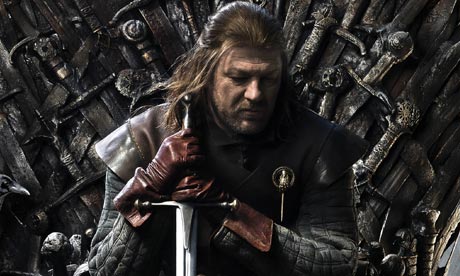
Writer: George R.R. Martin
Similar to Dune?
The back cover review establishes the book as being akin to “The Once and Future King,” but I think that, besides subject matter, it’s very different. I would say it more reminds me of Dune in Middle Earth, just taking the main characters of Dune and shattering them into various other characters in a series of interconnected storylines.
Like Dune, the characters are part of a complex and intricate world whose chief danger, at least for this book, is political (but, given overtones, will soon become mythical). Like Dune, there is a powerful character who seems poised to reclaim power through uniting nomadic tribes. While in Dune, Paul rides sandworms, our desert-savior, Dany, may very well have command over dragons.
As I read it, I was consistently picturing Eddard ‘Ned’ Stark as Leto Atreides, and Robert Baratheon (the King) as Vladimir Harkonnen. I can definitely see the two physical forms being parallel, as well as their attitudes toward power. However, where Leto is doomed, Ned has many opportunities, and where Vladimir is brilliant and cruel, Robert is vengeful and foolish. The Bene Gesserit have parallels in Thrones, from court viziers who may or not be wizards to shadow witches in the sea of grass. And everywhere, everywhere, Martin has politics. His detail work goes into familial lines and medieval research, on the feuds between families and individuals. He also a penchant for a bit of sex, which Dune omitted for studies of economies and ecologies.
I would say that where Frank Herbert went for big, big thinking, Martin likes to have a thousand small stories whirring at once, looking at series of personal, sexual, intimate relationships building and bleeding in a fantasy setting.
Arthurian Fantasy
To give credence to the back cover, his focus on knights, queens, and kings is strongly reminscent of the Arthur fantasies. He throws in magic, but only in sprinkles and hints in various places, either magic from before the current time or limited to a very secret and select few. In this way, his books closely resemble the Once and Future King and its predecessor works. Beyond the niche within fantasy, however, I think that Martin’s work has few similarities to the much lighter OFK. Martin prefers to deal with coming of age, change in a character, and sexual issues, than with fairy tale comparisons and song-like storylines. One reviewer described the series as ‘Sopranos in Middle Earth,’ which I can see, but I also more closely tie the first book, at least, to Dune.
Takeaways
I heard an interview the other day with George R.R. Martin where he said that he always wanted to use more characters than producers would like, so he started this project to fully use his cadre of characters. I would say that theory definitely applies to the Dune comparison: it seems that, for each Dune character, Thrones has seven more.
The cleverness of Thrones is that Martin uses all these stories to make intermingling arcs that allow him to jump (like a cut scene) from one story, place, and viewpoint, to another, entirely different. He cleverly titles each chapter with the narrator in question. Martin uses all these various stories to create a world, creating tension by leaving cliffhanger after cliffhanger.
I feel that, for his own writing style, this might have helped Martin go from ‘drive of an idea’ to ‘drive of another idea’ without getting tired. By the time his creative juices got tired in one chapter, he goes back to one of seven other narrators and viewpoints.
I also like that Martin uses a strong amount of dialogue. I am a playwright first and foremost, so reading his work made me a bit more hopeful. You’ll notice in my first chapter that I somewhat skimp on the full conversation, even though I am writing a ‘Tome of Tales.’ Martin uses dialogue liberally and well, allowing him to describe events without them being ‘true.’ His use of third person limited, allows us to see into the minds and opinions of one main character, which works excellently.
I think the character that most fascinated me was Jon Snow, though Tyrion Lannister is a personal favorite – his dialogue is some of the best in the book. I also thoroughly enjoy Dany’s arc, though at times I find her relegation to her sex a bit much. However, it really does give her a strong arc, considering where she winds up at the end of the book.
Gender Roles, Game of Thrones, and Fantasy
One hard issue to work with when dealing with fantasy is gender relations, chiefly because fantasy settings are generally placed in the medieval ages, when in our history, women had little power. For all that this kind of world is infused with sexism, the female characters are generally strong. Cersei is a power hungry and cunning Queen, Arya a willful girl who goes from riches to rags, but in a good way, Sansa spends most of the book in a fairy tale, though she is mature in her manners; Catelyn is decisive (if, at times, emotionally self-indulgent), and other strong women appear throughout the text as well.
One reason this is an issue especially in this text is the rate at which Martin works in sexual intimacy. Whores abound, bodies are explored and described, and while none of this is sexist per se, the world context is such that women really are things (by law) and the male gaze comes to the fore when dealing with them in almost any context. It is good that Martin does not shy away from these probable truths of the time, but I wonder that he does not somewhat allow his reader to revel in them as well.
I suppose my complaint is not with Martin, but with the knightly niche. If it’s a fantasy world, must it be a man’s world, even if we are placing it in a medieval setting? Given that its a fictional land, why do so many books adhere to a non-fictional history? Not an issue for Martin to resolve, just an observation on the genre.
Conclusions
Overall, I greatly enjoyed A Game of Thrones, and I look forward to the rest of this Song of Ice and Fire. I burned through the first book, each of the intricate storylines compelling me onward. I recommend it for anyone who wants to know what all the hype is about. Solid storytelling, brilliantly crafted world. Gallantry and swordplay with a political edge, marinated in sex, with a garnish of magic for flavor.
Hello loyal fans,
FINALLY! This is up and running on the youtubes. You may remember me blogging about it here and here.
Let me know your thoughts on the video, and of course, come see Ecce! It opens this Thursday night at 8:00pm, and I have a feeling it’s going to be pretty great.
Again, thanks for reading.
-K
I go by Auranach now, okay?
So, a few days ago, I made the worst decision of my life.
I bought Diablo 3.
Sure makes it seem warm and fuzzy, huh?
Now right off the back, I knew what class I wanted to be.
“Say it. Out Loud.”
“Demonhunter.”
I mean, the class looks very sick on the previews at the Blizzard Site.
Twin crossbows, flipping, traps, very Altair meets Van Helsing meets the kid that Hawkeye and Black Widow are totally gonna have.
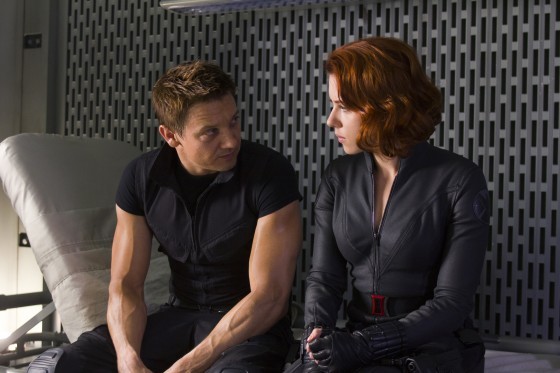
Totally.
And the sick twisted girl version of the character looks sweet. But I dunno, unlike Tyco of Penny Arcade, I am personally not down for playing a female character. I took a feminism course, and the one thing I now know is, I will never know what it’s like. So I decided to be a man about it.
But man, the dude version totally looks like a hipster.
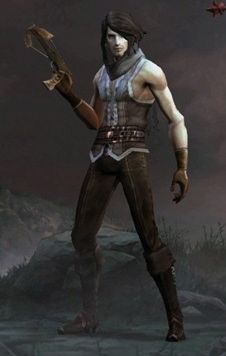
A Male Demon Hunter
An Hipster
Twins!
Having gotten the game last Friday, I now have a level 32 Demon Hunter (look at my life, look at my choices). Here are a few facts I’ve learned over the last 32 levels:
Fact 1: Demon Hunters were hunting demons before it was cool.
They weren’t in the last few games because they’re not ‘mainstream.’ They’re a new class with a new power system, not like ‘mana’ or ‘magic,’ but real things that happen all the time, like ‘hate’ and ‘discipline.’
Fact 2: Demon Hunters adventure to get those awesome leather pants
Because, with their workout regimen, it’s like, vacillating sizes and total surprises, yo.
Fact 3: Demon Hunters are artists
Caltrops, what? No, that’s my small business/ indie band symbol. But no big. Slows all the demons down while they’re like “that’s so true! speak to my soul!” word.
Fact 4: Demon Hunters take care of their own
Clothes, that it. Melee combat? So bloody. And those items are either rare or legendary, so no thank you! Not getting that dirty.
Fact 5: Demon Hunters Care
Most classes pursue unsustainable resources, while the demon hunter splits up their energy between an equal blend of angst and meticulousness.
Fact 6: It’s a Demon Hunter Thing
When you’re driven by equal parts hate and discipline, you don’t have time to explain yourself. You just have time to Hunt Demons. And leather pants.
These are facts. So put that gem in your socket and smoke it.
If the socket’s on a pipe, I guess.
Otherwise I’d save that gem for like, a sword. Or a better gem.
…Oh God, what have I done?
Nothing to do with vendors or rats on leashes here, just an expression.
Editing takes more time than one might think, given that for one minute, thirty seconds of footage, I’ve taken the better (or worse) part of three days to get this video underway.
So what takes up my time?
-Part 1: Importing Footage
Doesn’t take much time, this part, but finding just the right files meant that I spent my first half hour cleaning up my external hard drive (kind of like a room… I did wind up stuffing some files beneath the bed, as it were).
– Part 2: Labeling Footage
A minute thirty video isn’t too bad when it’s one continuous shot or a few shorts put together. But compressing two tech days (which, for my part, means about eight hours total) into one video can get a bit exhausting.
My usual label technique is name of the character or actor in the shot, what they say, and notes on their placement/ shot composition/ orientation.
I started by cutting down each clip for valuable footage, but now, I’ve finally just started labeling clips based on their initial moments. Maybe a bit lazy, but I am passing a deadline… ah, there it goes.
-Part 3: Artistry
Or at least a very life like simulation. Basically, I rearrange the footage to tell a story. What story? Well, that depends on the video, but usually there’s one driving theme to each video through which the images become part of an overall narrative.
I like to pick images that have either great color, shape, or static dynamism (they look awesome as they are), and failing that, I’m a fan of dramatic motion. I also like to mix close up shots and long shots, over the shoulder shots with profile images, people with props, so on and so on…
I also try to get the clip speed to match the pace of the video – beginning clips can go longer, climatic clips get much faster, and end clips are about even paced.
Then there’s the sound. For me, sound is the narrative element which i can continuously work on, which lets me move around sound bites to make amore compelling auditory narrative. Why is it more continuous than video? Because it requires the least rendering
– Part 4: Rendering
Or as I like to call, blogging time. Yes, true believer, even as I type these words, my final cut file is rendering its way to glory (or at least a very good approximation). Rendering is basically final cut saying “oh, you made that choice…” and judging me for a minute to several hours for what I’ve done to my precious raw footage. But to me, this part is necessary before I can fully review my work and continue
– Part 5: Editing
I know that this is what the whole process is called, so imagine that this is the Inception section, or the russian doll section. Whatever, there’s layers of editing. I think of this one like a comic artist or writer editing. You look at the steaming pile you’ve made on the canvas, take a good whiff, and dive in fingers first to sculpt it into something awesome. This is also how I make one-of-a-kind 3D portraits for my closest friends.
Metaphors aside, I take the parts I hate and I change them. Then I look over the whole thing to the best of my human ability, and godwilling… nope, something’s still off. So I keep on editing. And Marion Cotillard enters the room at times to sabotage my work.
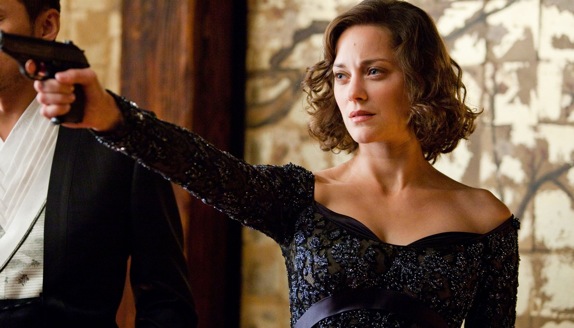
Marion, no!!!!!
Once that’s done and I’ve locked Marion back in my mental basement (sorry hon, it’s for the best. At least I remembered you off to the swank digs we had in Paris), I am ready for the final phase – Exporting, which is–
Your rival appears once more!
–first, I have to render the file again. But once I’ve gotten past that stupid L30 Wartortle (What!) I am ready for…
– Part 6: Exporting
I can see the light… I think, I think we’re almost there…
Yes, emerging from the smouldering debris of final cut pro, I have emerged with a minut thirty video. Now to send it off, see if it fits the bill, and if not, then we can go to part 4 again. Huzzah!
Thanks, kind reader, for your patience, lenience, and existence (bwhahaha)
-K
Hey all! So I’ve gotten the creative bug again.. ADing and teaching will do that to ya… and I am looking for DC based artists with which to collaborate in a playwright’s group. Any takers, let me know.
check out my penguins page to see just what happens when I listen to too much C-SPAN!

 actor | artist