Updated Film Work and Links

Uncategorized

For the past year, I’ve been working on Film projects, getting used to shooting and editing.  However, I haven’t made this part of the site easy to access yet: shouldn’t be a problem, as I don’t get too many readers, but for the odd ducks who stumble upon this site, I figure I’d make this section a bit easier on you.    I’ve updated and linked to video, so this part of the sight should flow easier now.

Go ahead and check out my updated Film Works section!

Still holding off on the videopress purchase; I need to get more regular media content on here already (I mean, what else are t2i’s for, anyway?)

Getting Underway: The Art of Swift Feedback

Theatre Business, Theatrical Process

Producing a show is a pretty fun experience, but it makes one realize – for all the technology in the world, if you want quick, productive feedback, nothing beats face to face meetings. I can think of no place more productive in terms of time spent than in a face to face collaborative meeting.

Now, I know there are nay-sayers out there – I’ve read Dilbert, after all – but in a super-collaborative process like theatre, face to face is vital. Now, granted, it’s not AS productive as the time one spends by oneself getting a task done, but for hashing out details, straightening out confusion, and getting everyone on the same page, the meeting just does it.

Granted, I have comparisons that I can make – other modes of discussion, for example. I find that, if its in writing, people will take more time to respond to it. If a meeting is verbal, the response is much swifter, and allows for a quicker flow of ideas.

In terms of collaborative clarity, here’s my hierarchy (best to worst):

-In Person Meeting (if there can be food/drinks there, so much the better). Everyone can see full expression from everyone else in the group, and there’s a sense of general commitment that comes with physical presence and generates, so far, a positive feeling.

– Skype/ Phone conversation – This is radio communication, basically – remote discussion. Very useful, very clarifying, very immediate. Not as fun or as personable as the in person meeting, but still very useful.

– Email. This is kind of a crapshoot. The shorter the email, the less info. The longer the email, the less someone will read. The least investment makes for the easiest upkeep but also means that it will inevitably get lost in an inbox.

– Texting. This is pretty much a precursor for any other kind of collaborative process. Short, sweet, to the point, not as strong a medium as a phonecall, with even less commitment than an email. Also, a crapshoot. This and the email can take the most time to get a bounceback response.

Granted, all these aspects are useful for collaboration and planning. But seriously, I really enjoy the social aspect of the meeting. It’s a wonderful excuse for friendly business/ arts folks to get together and hang out, while still getting things done.

I think basically this is a giant rant about how much I enjoy working with my artistic staff and marketing team.

Magic Paintbrush Gets Fantastic Review!

Uncategorized

Check it out here!
http://dctheatrescene.com/2011/03/01/the-magic-paintbrush/

Looking for Playwrighting Group

art, Theatre Business

Hey all!  So I’ve gotten the creative bug again.. ADing and teaching will do that to ya… and I am looking for DC based artists with which to collaborate in a playwright’s group.  Any takers, let me know.

11 at 11!

Uncategorized

hey folks! opening night was great! thanks for all the great attendance. We also have a show tomorrow, the 11th, at 11 am. Come see show II!

Two Days til opening Night!

Uncategorized

Tomorrow’s our big tech in the space!!! welcome to DC, cast!

Fringe Tickets Now onsale!

Theatre Business, Theatrical Process

Hey everyone!

Fringe tickets are now onsale at www.capitalfringe.org!  Come see Santa’s Helper!

One Month Until Opening Night!

Theatre Business, Theatrical Process

Santa’s Helper opens in just one month!  Make sure you get your tickets well in advance – Get a donor form and get your tickets reserved before they go on sale June 21st!

Sparkling Reviews for Bones at W+M

art, Theatrical Process

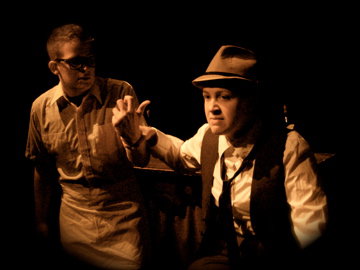
Ellis and Myers as Ruben and Reg, respectively.

Granted, by now this is old news, but it feels good to have wrapped up what felt like a fantastic show!

Anyway, Bones received two very positive reviews from our local student papers.  They can be found at the Dog Street Journal’s website and at that of the Flat Hat.  Many thanks to  Carrie Crow and Ian Goodrum, respectively.

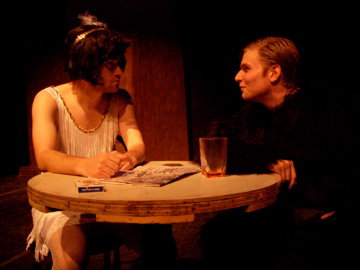
Ellis as Ruben and Murla as Benny in Peter Straughan's Bones

In addition, I wrote an Honors Thesis that tied to the show, and, 100 odd pages and a defense later, my Thesis has been submitted with Honors!  So, I feel pretty good about the process all in all.

I have to say that one of the coolest parts of doing this show was being facebook friended by a young lady who will be performing as Beck in Great Britain.  That is cross-continental communication occuring there!  It just, blows the mind.

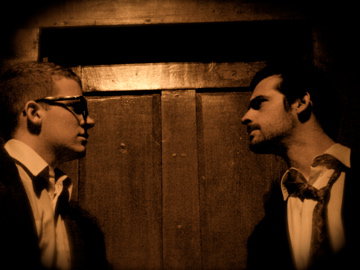
Powell as Beck and White as Moon in Peter Straughan's Bones

The final kicker for all of this hard work was the seven BOHICA awards that this show garnered.  BOHICAs are the W&M Theatre version of the Academy Awards, where our peers vote for our accolades.  Bones won, all in the Second Season category: Best Lead Actor, Best Lead Actress, Best Supporting Actor, Best Ensemble, Best Lighting Design, Best Director, and Best Show.

That said, some thanks are in order.  The cast of this show was comprised of persons who were not only excellent actors, but who were great people with whom I would definitely work again at the drop of a hat.  Their talent and dedication made me look good, while I pretty much got to sit back and enjoy great theatre in the making day after day.  Furthermore, I have to thank my no less dedicated crew, whose long hours, gung-ho attitudes, and incredible expertise helped me make a visually awesome show.

Thank you all for helping me put on such a phenomenal senior directorial!

For those of you who were unable to see the show, check out this awesome video by Silk and Silver Productions!

Additive Architecture

Environmental Architecture

Considering the fields of Theatre, Economics, Environmental Sustainment, and Architecture, I’m beginning to feel that a more conservative approach to the Green movement is necessary.  There are plenty of locations where mega-mansions are being built, huge, new, Green houses that take a lot of money and time and labor, but will eventually pay for their own costs.  What I’d like to see more of is tweaking: taking existing spaces and making them more green without demolishing them.  In other words, using the resources that are in place and making them more efficient.  One could say I’m advocating ‘baby steps’ in Architectural Sustainability, but there are more factors to consider in the Green movement than ‘houses that pay for themselves.’

What I’ve seen so far that I’ve liked includes the Gable House, a structure built using ‘lamboo’ – laminated bamboo – and resources from condemned farms, to build a house.  What’s excellent about these two materials is that the first is rapidly renewable – bamboo is a grass and if improperly contained, becomes an invasive weed; and that the second is a reused resource – in essence, it’s good waste management.

Detractors say that liberal approaches to Green Architecture lead to a higher carbon footprint in that resources must be transported to a site to build, whereas more conservative approaches lead to less transport and building.  They also argue for conservation of culture – especially those interested in historical landmarks.  I don’t entirely disagree with them.  However, living in Colonial Williamburg, I will say that over- conservation eventually leads to marketed celebration and a biased viewpoint of history.  In other words, nostalgia, like all things, should be taken in moderation.

Now that I’ve poo-poo’d CW, I will laud it: several years ago, the Foundation switched over to less authentic electric candles.  Preservation is important, but only to a certain extent.  If the Colonies had had electricity, I’m sure they would have used it.  After all, history shows that eventually, they did.

Anyway, what I’m saying is that one need not build an entirely new building in order to produce a grand eco-site.  Especially those in theatre, who someitmes used condemned buildigns as playign spaces.  Theatre should act both as a conservative function of culture and a progressive one.  By using the old ways and the tried and true aspects of a culture, it can also act to fix problems within a given society.

Looking at that role, one can extrapolate the ideology to architecture.  Rather than destroying condemned sites to build new green spaces, one can modify a dilapidated space into a more useful and efficient site.  This allows for both progressive movements in architecture and culture as well as a preservation of history and a conservation and reuse of resources. Especially in the Theatre, this approach would allow organizations to make a sustainable home while still paying homage to their roots (or at least their patron houses).